What Happens If You Divorce Before Getting a Permanent Green Card?
What Happens If You Divorce Before Getting a Permanent Green Card?
Your marriage is ending. Your green card isn't approved yet. Now what?
This is one of the most stressful questions an immigrant in the US can face. You came here through a genuine marriage, built a life here — and now that marriage is falling apart. Meanwhile, your immigration status is still tied to it.
The situation is serious. But it is not hopeless. USCIS has a legal pathway specifically for this scenario, and thousands of conditional residents successfully obtain permanent green cards after divorce every year.
What matters is understanding your situation quickly — and not making costly mistakes.
First: understand what kind of green card you have
The answer to "what happens" depends entirely on where you are in the green card process.
Scenario A: Your marriage-based green card hasn't been approved yet
If you're still waiting for USCIS to approve your initial application and the marriage ends before approval — the case generally cannot move forward on that basis. A marriage-based application requires an ongoing qualifying relationship. If the marriage ends before approval, the petition loses its foundation. You would need to explore other paths to legal status — a different visa category, VAWA self-petition if abuse was involved, or starting over later.
Scenario B: You have a conditional green card (2-year card)
This is the most common situation. If your marriage was less than two years old when your green card was approved, you received a conditional permanent resident status — a 2-year green card. The rest of this article focuses on this scenario.
What a conditional green card means — and why divorce changes everything
Your 2-year conditional green card has an expiration date and a built-in requirement: before it expires, you must file Form I-751, Petition to Remove Conditions on Residence, to convert it into a permanent 10-year green card.
Under normal circumstances, you file I-751 jointly with your US citizen or permanent resident spouse. Divorce changes that. If your marriage ends, a joint filing is no longer possible — but USCIS has a solution.
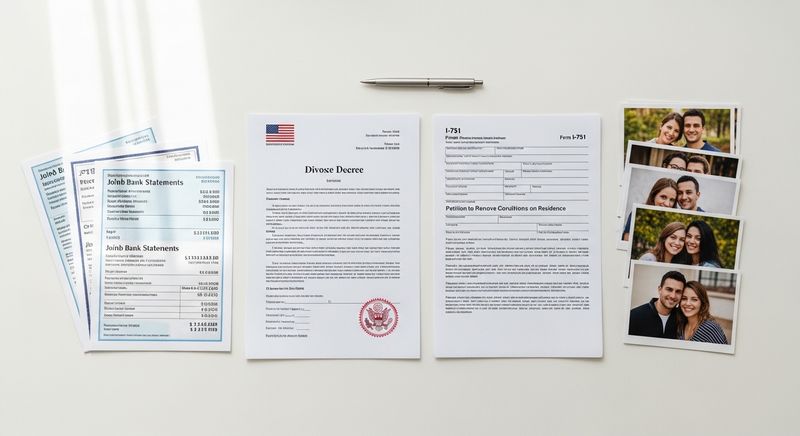
The I-751 divorce waiver: your path forward
USCIS allows conditional residents to file I-751 alone, without their former spouse, by requesting a waiver of the joint filing requirement. This is known as the divorce waiver.
It does not matter if you left the marriage or initiated divorce proceedings. You do not need to prove that the divorce was your spouse's fault. What you do need to prove is that the marriage was entered into in good faith — that it was a real marriage when it started, not a sham arrangement for immigration purposes.
Timing: when can you file?
If your divorce is final: you can file Form I-751 as soon as your divorce is final - you don't have to wait for the 90-day window before your conditional card expires.
If your divorce is still pending: USCIS will accept your I-751 and then send a Request for Evidence asking for the final divorce decree within 87 days. If your divorce is not finalized within that window, the situation becomes significantly more complicated.
If your conditional card is about to expire and divorce isn't final: file I-751 immediately. Do not wait. Include documentation showing proceedings have started and explain the situation in a written statement.
Important: a separation agreement does not count. The divorce must be complete - wait for the court's final judgment.
What happens to your status while I-751 is pending?
Once USCIS issues your receipt notice, your conditional residency is automatically extended for 48 months. You can work legally using your expired card plus receipt notice. You can also travel outside the United States - carry both documents when traveling.
Processing times: as of 2026, I-751 divorce waiver cases typically take 22 to 26 months. Plan accordingly.

What evidence you need to submit
Your I-751 divorce waiver package must demonstrate two things: that your marriage was genuine when it started, and that it has legally ended.
To prove the marriage was genuine:
- Joint bank account statements from during the marriage
- Joint federal tax returns
- Shared lease or mortgage documents
- Utility bills at the same address
- Photos together — travel, family events, milestones
- Affidavits from people who knew you as a couple
- Health or life insurance showing the other as beneficiary
- Birth certificates of any children born during the marriage
To prove the marriage has ended:
- Final divorce decree or annulment document
- If divorce is pending: court filings showing proceedings have started
To explain the circumstances:
USCIS expects a personal written statement explaining why the marriage ended. Be honest and factual. Avoid language that makes the breakup sound like it was always inevitable — that raises fraud concerns.
A critical red flag to watch for
If your US spouse included "bad faith" in the divorce grounds — meaning they claimed under oath that the marriage was fake — your waiver case becomes significantly harder. This is not insurmountable, but it requires strong counter-evidence and almost certainly the help of an immigration attorney.
Other waiver options
Battery or extreme cruelty (VAWA): if you experienced abuse during the marriage, you may self-petition under the Violence Against Women Act — this applies to both women and men.
Extreme hardship: if removing you from the US would cause extreme hardship beyond what is typical, you may qualify. This is a high bar but can be combined with other waiver grounds.
Death of the petitioning spouse: if your US citizen or permanent resident spouse passed away, you file individually with evidence of the marriage and the death certificate.
What happens if I-751 is denied?
If your petition is denied, your conditional resident status ends immediately. USCIS will usually send your case to immigration court for removal proceedings, where a judge can review the decision. This is why filing correctly with complete evidence matters — a weak or incomplete package can result in denial with serious consequences.
Bottom line
Divorcing before you have a permanent green card is a serious situation, but USCIS has a defined process for it. The I-751 divorce waiver exists precisely for this scenario. You can file alone, you don't need your ex-spouse's cooperation, and you don't need to prove the divorce was their fault.
What you do need is strong evidence that your marriage was genuine when it started — and you need to file before your conditional card expires.
If your situation involves any complexity — a spouse who claimed the marriage was fake, prior removal proceedings, late filing, or pending divorce - consult a licensed immigration attorney before you file.
Disclaimer: This article is for informational purposes only and does not constitute legal advice. Immigration law is complex and highly fact-specific. Consult a licensed immigration attorney for guidance on your individual situation.